

The Future of Food Packaging: 5 Trends Shaping Efficiency, Safety and Sustainability
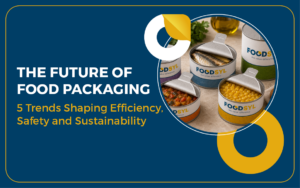
Cost efficiency, safety and sustainability are transforming the way food packaging is designed. FOODSYL embraces this evolution with a solution developed to meet the changing needs of the food industry.
THE NEW DEMANDS OF FOOD PACKAGING
The food industry is facing new challenges. To remain competitive, companies need to control costs while maintaining high standards of safety, quality and sustainability.
In this context, food packaging is taking on an increasingly strategic role. Packaging is no longer simply a means of containing and protecting a product, but a key component that can influence production, efficiency, consumer experience and brand perception.
This evolution is also driving the need to rethink established solutions, such as those traditionally used for food and metal cans. FOODSYL is part of this transformation, offering an easy-peel sealing system made with aluminium foil, designed to combine functionality, simplicity and new opportunities for manufacturers, brands and consumers.
1.EFFICIENCY AND COST CONTROL
The pursuit of greater efficiency will be one of the key priorities for the food industry. Optimising resources also means rethinking how products are packaged, reducing materials, components and production complexity.
FOODSYL addresses this need with a system that replaces the traditional ring pull tab with a heat-sealed aluminium foil, helping to simplify the packaging structure and optimise packaging costs.
2.PRODUCT SAFETY AND PROTECTION
Food safety remains an essential requirement for any packaging solution. Packaging must protect the product throughout the entire supply chain and provide an effective barrier until the moment of opening.
With FOODSYL, the heat-sealed aluminium foil creates a complete barrier that protects the product until opening. The absence of the traditional metal ring pull also contributes to making the system simpler and more convenient to use.
3.SIMPLER PRODUCTION PROCESSES
Innovation in food packaging also involves production processes: fewer steps, fewer components and reduced mechanical complexity can all contribute to greater production efficiency.
The FOODSYL system does not require double seaming, simplifying one of the key stages in the can manufacturing process and representing one of the solution’s main advantages.
4.SUSTAINABILITY AND RECYCLABLE MATERIALS
Sustainability will continue to be one of the key drivers of innovation in packaging. When designing packaging solutions, the choice of materials and their recyclability are becoming increasingly important factors.
FOODSYL uses 100% aluminium foil, a monomaterial that is fully recyclable. Sustainability becomes an integral part of the system’s design, alongside functionality and efficiency.
5.PACKAGING AND BRANDING
Food packaging is increasingly becoming a tool for communication and product enhancement. In a competitive market, design and branding help products stand out on the shelf and strengthen brand recognition.
FOODSYL expands the possibilities for brand customisation: the aluminium foil can be printed, turning the top of the can into a dedicated space for the product’s visual identity.
The result is premium, contemporary and customisable packaging, designed to enhance the product and make the brand immediately recognisable.
THE FUTURE OF FOOD PACKAGING
Innovation will continue to drive the evolution of food packaging. For manufacturers and brands, this means looking for solutions that can improve efficiency, simplify production, meet sustainability goals and create new opportunities to enhance the product.
FOODSYL embraces this evolution by starting with a fundamental element of the can: the sealing system.
Rethinking it means transforming a traditional component into an opportunity for innovation.
Discover FOODSYL